Happy Birthday in 30 Languages
Wishing someone a happy birthday in their own language is a small gesture that often means a lot. A coworker who moved from another country, a neighbor who grew up speaking a different language at home, or a friend's grandmother who never fully switched to English may all smile at hearing a familiar phrase on their special day.
Below you'll find 30 birthday greetings grouped by region. Each one shows the phrase as it is written, a simple romanization where the language uses a non-Latin script, and a rough pronunciation hint for English speakers. The hints are approximations, not perfect phonetics, so treat them as a starting point and listen to native speakers whenever you can.
Western and Southern Europe
These are some of the most widely spoken languages in the world, so they are the ones you are most likely to need. Stressed syllables are shown in capital letters.
- Spanish: ¡Feliz cumpleaños! (feh-LEES koom-pleh-AH-nyos)
- French: Joyeux anniversaire ! (zhwah-YUH zah-nee-vehr-SEHR)
- German: Alles Gute zum Geburtstag! (AH-les GOO-teh tsoom geh-BOORTS-tahk)
- Italian: Buon compleanno! (bwon kom-pleh-AHN-noh)
- Portuguese: Feliz aniversário! (feh-LEES ah-nee-ver-SAH-ree-oo)
- Dutch: Gefeliciteerd met je verjaardag! (khuh-feh-lee-see-TEERT met yuh fer-YAR-dahkh)
Northern Europe
The Nordic languages look intimidating on paper, but the greetings are short and people are usually delighted when a visitor tries them. Swedish, Norwegian and Danish are closely related, so the phrases share a family resemblance.
- Swedish: Grattis på födelsedagen! (GRAH-tis poh FUR-del-seh-dah-gen)
- Norwegian: Gratulerer med dagen! (grah-too-LEH-rer meh DAH-gen)
- Danish: Tillykke med fødselsdagen! (tee-LUE-keh meh FUR-sels-day-en)
- Finnish: Hyvää syntymäpäivää! (HUE-vaa SUEN-tue-mah-pai-vaa)
Central and Eastern Europe
Several of these phrases do not translate word for word as "happy birthday." The Polish and Czech greetings mean "all the best," and the Romanian one means "many years." They are still the standard birthday wishes in each language. The Greek phrase is also used for name days and holidays, so it works on many happy occasions.
- Polish: Wszystkiego najlepszego! (fshist-KYEH-goh nai-lep-SHEH-goh)
- Czech: Všechno nejlepší k narozeninám! (FSHEKH-noh NEY-lep-shee k NAH-roh-zeh-nee-nahm)
- Hungarian: Boldog születésnapot! (BOL-dog SUE-leh-taysh-nah-pot)
- Romanian: La mulți ani! (lah MOOLTS AHN)
- Croatian: Sretan rođendan! (SREH-tahn ROH-jen-dahn)
- Greek: Χρόνια πολλά! Chrónia pollá (HROH-nyah poh-LAH)
- Russian: С днём рождения! S dnyom rozhdeniya (s DNYOM rahzh-DYEH-nee-yah)
Middle East and Africa
Arabic, Hebrew and Persian are written from right to left. If you are writing one of these greetings on a card, copy it carefully from a reliable source or ask a native speaker to check it, because letters change shape depending on their position in a word.
- Arabic: عيد ميلاد سعيد, Eid milad sa'eed (eed mee-LAAD sah-EED)
- Hebrew: יום הולדת שמח, Yom huledet sameach (yohm hoo-LEH-det sah-MEH-akh)
- Persian (Farsi): تولدت مبارک, Tavallodet mobarak (tah-vahl-loh-DET moh-bah-RAHK)
- Turkish: İyi ki doğdun! (ee-YEE kee doh-DOON)
- Swahili: Heri ya siku ya kuzaliwa! (HEH-ree yah SEE-koo yah koo-zah-LEE-wah)
Asia and the Pacific
Some Asian languages have different levels of politeness built into the grammar. The versions below are polite forms that are safe with almost anyone. With close friends and family, Japanese speakers often drop "gozaimasu" and Korean speakers often say "saengil chukhae" instead.
- Mandarin Chinese: 生日快乐, Shēngrì kuàilè (shung-ruh kwai-luh)
- Japanese: お誕生日おめでとうございます, O-tanjōbi omedetō gozaimasu (oh-tahn-JOH-bee oh-meh-deh-TOH goh-zai-mahs)
- Korean: 생일 축하합니다, Saengil chukha-hamnida (seng-eel choo-kah-hahm-nee-dah)
- Hindi: जन्मदिन की शुभकामनाएँ, Janmadin ki shubhkamnayein (JUN-muh-din kee shoobh-kahm-nah-YEN)
- Thai: สุขสันต์วันเกิด, Suk san wan koet (sook-sahn wahn GURT)
- Vietnamese: Chúc mừng sinh nhật! (chook muhng sing nyuht)
- Indonesian: Selamat ulang tahun! (seh-LAH-maht OO-lahng TAH-hoon)
- Filipino (Tagalog): Maligayang kaarawan! (mah-lee-GAH-yahng kah-ah-RAH-wahn)
How to Use a Greeting in Someone's Language Respectfully
A greeting in someone's home language is a kind gesture, but it works best when it feels sincere rather than like a performance. Use the phrase once, warmly, and then carry on in the language you normally share. You don't need to turn the moment into a language lesson.
Make sure you have the right language. Do not assume a language from someone's appearance, name or accent. Many people grew up with more than one language, and some may prefer the one they use with their own family. If you are not sure, it is perfectly polite to ask a few days beforehand, for example, "How do people say happy birthday in your family?" Most people enjoy being asked.
Practice the pronunciation in advance. Listening to a native speaker once or twice will help much more than reading a hint on a page. If you mispronounce it on the day, smile and move on. The effort is what people remember.
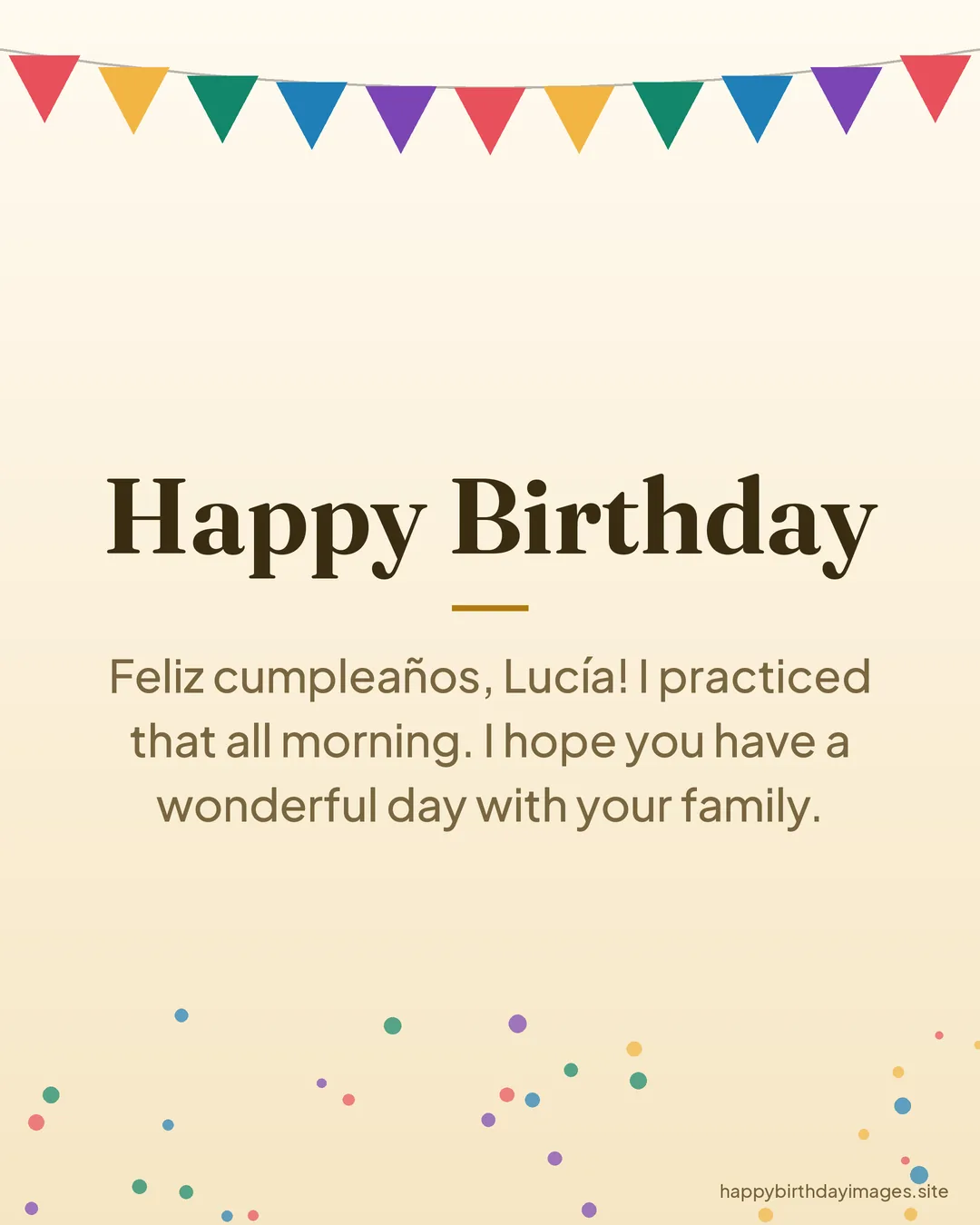
ExampleFeliz cumpleaños, Lucía! I practiced that all morning. I hope you have a wonderful day with your family.
Writing a Greeting on a Card
A foreign-language greeting works nicely as the opening line of a birthday card, followed by your usual message in your shared language. This keeps the card personal and makes sure the rest of your message is fully understood.
Spelling and accents matter in writing. Leaving out the tilde in "cumpleaños" or the dots in "Hyvää" can change how a word looks or even what it means, so copy each letter exactly. For non-Latin scripts, it is safer to print the greeting from a trusted source or ask someone who reads the language to look at it before you write it by hand.
- Write the greeting first, then your personal message underneath
- Copy accents and special letters exactly as shown
- For right-to-left scripts, write the phrase as one block and check the letter order
- If you are unsure, use the romanized version rather than guessing at the script
Group and Workplace Settings
If a whole team wants to greet a colleague in their language, agree on a single phrase so everyone uses the same version. Put it at the top of the group card or say it together at the start of a small celebration.
Keep it light and inclusive. The aim is to make the person feel recognized, not singled out. If the colleague seems shy about attention, a quiet greeting from one person in their language may mean more than the whole office trying it at once.
Frequently asked questions
Is it rude to say happy birthday in someone's language if I pronounce it badly?
Usually not. Most people appreciate the effort far more than they notice small mistakes. Practice a few times beforehand, say it with a smile, and don't worry if it comes out imperfectly.
Should I use the formal or informal version?
When in doubt, use the polite form, especially with older people, managers or people you have just met. Among close friends, the casual form feels more natural. If you know a native speaker, ask them which version suits the relationship.
Why are some greetings not a literal "happy birthday"?
Every language has its own customs. In some, the usual birthday wish means "all the best" or "many years," and that phrase is simply what people say on birthdays. Using the customary phrase sounds more natural than a word-for-word translation.
Can I write a greeting in another script if I can't read it?
Yes, but take care. Copy it from a reliable source, check that every character matches, and ideally ask someone who reads the language to confirm it. If that isn't possible, the romanized version is a safe alternative.
Ready-to-use messages


More guides
 6 min readBirthday Card Etiquette: A Practical GuideWhen to send a birthday card, how to sign it, what to do about late cards, and how to handle group cards at work without overthinking it.
 6 min readSimple Ways to Celebrate a Birthday at HomeLow-cost, family-friendly ways to celebrate a birthday at home, from breakfast surprises and easy decorations to games, movie nights, and a planning timeline.
 6 min readPractical Birthday Gift Ideas for Every AgeGift ideas organized by age group, from toddlers to grandparents, with budget-friendly options and experiences that people actually remember.